Annual Party & Membership Meeting, Dec. 2 at Varsity Club
See the event page here: https://kcrta.org/event/2026-annual-party-membership-meeting/

See the event page here: https://kcrta.org/event/2026-annual-party-membership-meeting/
Topline
The Mid-America Regional Council (MARC) is responsible for leading the regional transportation planning for the bi-state Kansas City metro. One of the ways that they have done that is through their Smart Moves Plan.
As MARC explains, the Smart Moves Plan is meant to serve as the long-range transit plan for the region. More specifically, the plan:
You can learn more about the plan by clicking here. The project website has plenty of good information about the plan and insights based on their research. They have also released a survey where they’re asking people for their insights on how they experience transit today.
There’s plenty to be excited about with the updated plan, but there’s a lot to take in and digest. That’s why MARC is organizing a series of public meetings to share details with everyday folks and get feedback on how to make the final version of the update even better.
Plan to attend one of the four scheduled meetings across the region:
Wyandotte County Open House
Tuesday, November 3, 2026
4:30 – 6:30pm
West Wyandotte Library
1737 N. 82nd Street [map] [Route 116]
Kansas City, KS 66112
Johnson County Open House
Thursday, November 5, 2026
4:30 – 6:30pm
Central Resource Library
9875 W. 87th Street [map] [Route 487]
Overland Park, KS 66212
Northland Open House
Monday, November 9, 2026
4:30 – 6:30pm
Mid-Continent Public Library
8700 N. Oak Trafficway [map] [Route 201]
Kansas City, MO 64155
Jackson County Open House
Monday, November 16, 2026
4:30 – 6:30pm
Plaza Library
4801 Main Street [map] [KC Streetcar | Route 35 | Route 47 | Route 50 | Route 401]
Kansas City, MO 64112
The Smart Moves Plan is a key document to guide our efforts to create a strong and reliable system for regional transit. In order to take the plan from the paper to the pavement, the KCRTA needs YOU to learn more about the plan and make your voice heard on how this document should be shaped and finalized.
First, a big thank you! The number of riders, advocates, employers, and community members who reached out to legislators this past session on the importance of transit investment was exceptional. Because of your voices, Missouri transit funding held on to $4.2 million — a decrease from prior years, but not the $0 that was on the table. That result was not guaranteed. It happened because people showed up and spoke up.
Now, it’s time to do it again.
While the next legislative session is still months away, the real work on the state budget begins much sooner. In October, Governor Mike Kehoe’s administration starts building the budget proposal that will be unveiled in January. This is the moment when transit riders, advocates, employers, community organizations, and other stakeholders can shape the conversation before it ever reaches the legislature.
In August, the Missouri Highway and Transportation Commission approved MoDOT’s SFY 2028 State Transit Assistance request, totaling $9 million:
This request comes after two years of significant decline in state investment in public transit, driven by broader state budget challenges. The MPTA has sent a letter to the Governor’s office outlining why restoring this funding matters — but administration officials need to hear directly from the people and communities transit serves.
Contact the Governor’s Office
Reach out to Governor Kehoe’s office and share why transit investment matters in your community. Specific, personal stories make the strongest case — how transit gets you to work, to medical appointments, to school, or keeps your business staffed and your community connected.
Write Your Local Paper
A letter to the editor in our local media is a powerful, public way to make the case for state transit investment — and it reaches both the public and policymakers.
Spread the Word
Share this post with peers, colleagues, riders, and other stakeholders. The more voices weighing in now, before the Governor’s budget is finalized, the stronger the case for transit funding in January.
For questions or to get more involved, contact the Kansas City Regional Transit Alliance.
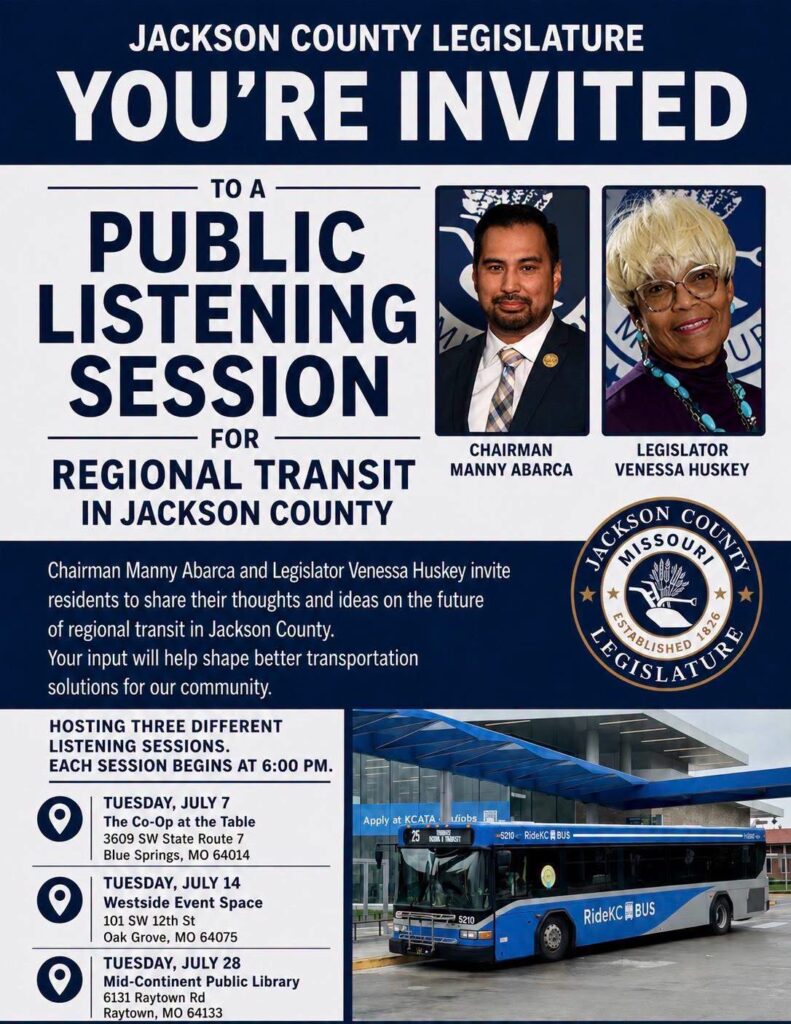
The Jackson County Legislature is considering a dedicated sales tax for public transportation and has scheduled listening sessions throughout the County in July to hear thoughts and ideas from residents on “the future of regional transit in Jackson County.”
Jackson County provides no transit service today. Previous efforts to secure funding for a regional rail proposal disintegrated after KCRTA led an education campaign (“Transit Works For Us”) leading up to a potential sales tax vote in 2012, for which the County acquired a 17.7-mile segment of railroad right-of-way that eventually became the Rock Island Trail.
Our July 2025 poll indicated a majority support for a 1/2-cent dedicated sales tax for bus transit.
KCUR: Jackson County could vote on transit tax to help fund buses. Residents can weigh in now
Varying majorities of voters in four polled counties support creating dedicated funding for public transit.
Overview
Read on for more information.
The Kansas City Regional Transit Alliance (KCRTA) has developed a county-based transit funding strategy and is now working to build support for this new regional funding mechanism.
Acknowledging that regional cooperation can be challenging on any issue, this strategy instead asks each county in the region to establish their own dedicated transit funding stream for operations and then, if voters approve on that county’s timeline, that county would determine the governance model and services for that transit investment.
The current system has individual governments fund transit from their general revenue, which leaves our system underfunded and our regional economy lagging our peers. The notable exception is Kansas City, Missouri, with two dedicated citywide transit sales taxes and a special district to fund the streetcar.
To better understand where voter sentiment is on the issue of transit funding, KCRTA worked with partners across the region to develop and commission a poll of voters in the Kansas City area. These voters were located in four counties: Clay, Jackson, Johnson, and Wyandotte Counties. The poll, conducted in late July 2025 by EMC Research, reached 400 voters in each county and has a regional margin of error of +/- 3.1 percentage points (county-level margins of error vary and are available in the memo for each county).
Regardless of whether they personally use public transit, a majority of voters expressed the belief that public transit is a public good that deserves additional public funding.
Poll results are listed below:
Q: Next year, there may be a measure on the ballot in [COUNTY] that would increase the local sales tax by 1/2¢ for 10 years to fund public transit bus services in [COUNTY]. If the election were held today, would you vote yes to approve or no to reject this measure?
| County | % Yes Uninformed | %Yes After Messages* |
| Clay | 53% | 54% |
| Jackson | 57% | 61% |
| Johnson | 52% | 56% |
| Wyandotte | 50% | 57% |
*“After Messages” means the share of voters who would vote yes for a transit measure after hearing potential reasons why the measure could be beneficial.
With these results, KCRTA plans to take key steps in the coming months to build upon this information. That will include:
If you’re interested in learning more, please contact us at chair@kcrta.org.
About the Kansas City Regional Transit Alliance: The Kansas City Regional Transit Alliance is a non-profit organization that educates the public on transit accessibility, gathers public opinion, communicates, and advocates to expand, enhance, and improve today’s transit options. Our mission is to expand, enhance, and improve mass transit in the Kansas City region.
61% of voters polled would support dedicated transit funding in Jackson County.
Overview
Read on for more information.
The Kansas City Regional Transit Alliance (KCRTA) has developed a county-based transit funding strategy and is now working to build support for this new regional funding mechanism.
Acknowledging that regional cooperation can be challenging on any issue, this strategy instead asks each county in the region to establish their own dedicated transit funding stream for operations and then, if voters approve on that county’s timeline, that county would determine the governance model and services for that transit investment.
Jackson County currently has the highest amount of transit service in the Kansas City region, due largely to the two dedicated sales taxes in Kansas City, Missouri. Other cities within Jackson County have significant transit needs that cannot be met with existing funding levels. In particular, Independence recently eliminated all fixed route bus service. Grandview also recently cut its bus route. Even in Kansas City, service has been cut due to rising costs and diversion of sales tax funds to other City priorities. There are many plans being crafted for new transit service in Jackson County, including the Bi-State Sustainable Reinvestment Corridor and the East-West Transit corridor. These priorities and others will require local funding to support ongoing operations as well as a local match for any Federal grants.
To better understand where voter sentiment is on the issue of transit funding, KCRTA worked with partners across the region to develop and commission a poll of voters in the Kansas City area. These voters were located in four counties: Clay, Jackson, Johnson, and Wyandotte Counties. The portion of the poll which covered Jackson County, conducted in late July 2025 by EMC Research, reached 400 voters in each county and has an overall margin of error of +/- 4.9 percentage points.
Regardless of whether they personally use public transit, a majority of Jackson County voters believe it is a public service worthy of additional public funding. Poll results are listed below:
Q: Next year, there may be a measure on the ballot in [COUNTY] that would increase the local sales tax by 1/2¢ for 10 years to fund public transit bus services in [COUNTY]. If the election were held today, would you vote yes to approve or no to reject this measure?
| 57%Yes, Uninformed | 61%Yes, After Messages* |
*“After Messages” means the share of voters who would vote yes for a transit measure after hearing potential reasons why the measure could be beneficial.
Q: When voters were asked whether or not they agree or disagree with each of the following statements:
Q: For each of the following items that could be included in a future sales tax measure to fund public transit bus services, please indicate if you support or oppose that item.
| Issue | Total Support |
| Improving and adding sidewalks to protect pedestrian safety | 77% |
| Improving the safety of public buses and bus stops | 75% |
| Improving, expanding, and maintaining bike trails and bike share | 45% |
| Increasing the number of KCATA bus routes and stops in Johnson County | 54% |
| Increasing the frequency of KCATA bus service | 51% |
With these results, KCRTA plans to take key steps in the coming months to build upon this information. That will include:
If you are interested in learning more, please contact us at chair@kcrta.org.
About the Kansas City Regional Transit Alliance: The Kansas City Regional Transit Alliance is a non-profit organization that educates the public on transit accessibility, gathers public opinion, communicates, and advocates to expand, enhance, and improve today’s transit options. Our mission is to expand, enhance, and improve mass transit in the Kansas City region.
54% of voters polled would support dedicated transit funding in Clay County.
Overview
Read on for more information.
The Kansas City Regional Transit Alliance (KCRTA) has developed a county-based transit funding strategy and is now working to build support for this new regional funding mechanism.
Acknowledging that regional cooperation can be challenging on any issue, this strategy instead asks each county in the region to establish their own dedicated transit funding stream for operations and then, if voters approve on that county’s timeline, that county would determine the governance model and services for that transit investment.
Transit challenges have grown more pressing in Clay County and the entire Northland in recent years. Communities such as Liberty and Gladstone have eliminated fixed-route service due to low ridership and other hurdles that emerged as a result of the pandemic. While on-demand services like IRIS have provided some relief, they are not the long-term solution that Clay County residents need.
To better understand where voter sentiment is on the issue of transit funding, KCRTA worked with partners across the region to develop and commission a poll of voters in the Kansas City area. These voters were located in four counties: Clay, Jackson, Johnson, and Wyandotte Counties. The portion of the poll which covered Clay County, conducted in late July 2025 by EMC Research, reached 400 voters in each county and has an overall margin of error of +/- 4.9 percentage points.
Regardless of whether they personally use public transit, a majority of Clay County voters believe it is a public service worthy of additional public funding. Poll results are listed below:
Q: Next year, there may be a measure on the ballot in [COUNTY] that would increase the local sales tax by 1/2¢ for 10 years to fund public transit bus services in [COUNTY]. If the election were held today, would you vote yes to approve or no to reject this measure?
| 53%Yes, Uninformed | 54%Yes, After Messages* |
*“After Messages” means the share of voters who would vote yes for a transit measure after hearing potential reasons why the measure could be beneficial.
Q: When voters were asked whether or not they agree or disagree with each of the following statements:
Q: For each of the following items that could be included in a future sales tax measure to fund public transit bus services, please indicate if you support or oppose that item.
| Issue | Total Support |
| Improving and adding sidewalks to protect pedestrian safety | 80% |
| Improving the safety of public buses and bus stops | 69% |
| Improving, expanding, and maintaining bike trails and bike share | 45% |
| Increasing the number of KCATA bus routes and stops in Johnson County | 56% |
| Increasing the frequency of KCATA bus service | 49% |
With these results, KCRTA plans to take key steps in the coming months to build upon this information. That will include:
If you are interested in learning more, please contact us at chair@kcrta.org.
About the Kansas City Regional Transit Alliance: The Kansas City Regional Transit Alliance is a non-profit organization that educates the public on transit accessibility, gathers public opinion, communicates, and advocates to expand, enhance, and improve today’s transit options. Our mission is to expand, enhance, and improve mass transit in the Kansas City region.
56% of voters polled would support dedicated transit funding in Johnson County.
Overview
Read on for more information.
The Kansas City Regional Transit Alliance (KCRTA) has developed a county-based transit funding strategy and is now working to build support for this new regional funding mechanism.
Acknowledging that regional cooperation can be challenging on any issue, this strategy instead asks each county in the region to establish their own dedicated transit funding stream for operations and then, if voters approve on that county’s timeline, that county would determine the governance model and services for that transit investment.
Johnson County finds itself at a crossroads when it comes to how to operate its public transit system. Their public transportation system transports about 379,000 riders a year on fixed routes, as well as 84,000 paratransit riders and over 32,000 microtransit riders. As Johnson County Transit develops its strategic plan, it is also studying a rapid transit route on Metcalf Avenue. Increased service levels Countywide and on Metcalf would require additional funding to ensure consistent operations.
To better understand where voter sentiment is on the issue of transit funding, KCRTA worked with partners across the region to develop and commission a poll of voters in the Kansas City area. These voters were located in four counties: Clay, Jackson, Johnson, and Wyandotte Counties. The portion of the poll which covered Johnson County, conducted in late July 2025 by EMC Research, reached 400 voters in each county and has an overall margin of error of +/- 4.9 percentage points.
Regardless of whether they personally use public transit, a majority of Johnson County voters believe it is a public service worthy of additional public funding. Poll results are listed below:
Q: Next year, there may be a measure on the ballot in [COUNTY] that would increase the local sales tax by 1/2¢ for 10 years to fund public transit bus services in [COUNTY]. If the election were held today, would you vote yes to approve or no to reject this measure?
| 52%Yes, Uninformed | 56%Yes, After Messages* |
*“After Messages” means the share of voters who would vote yes for a transit measure after hearing potential reasons why the measure could be beneficial.
Q: When voters were asked whether or not they agree or disagree with each of the following statements:
Q: For each of the following items that could be included in a future sales tax measure to fund public transit bus services, please indicate if you support or oppose that item.
| Issue | Total Support |
| Improving and adding sidewalks to protect pedestrian safety | 71% |
| Improving the safety of public buses and bus stops | 65% |
| Improving, expanding, and maintaining bike trails and bike share | 53% |
| Increasing the number of KCATA bus routes and stops in Johnson County | 50% |
| Increasing the frequency of KCATA bus service | 47% |
With these results, KCRTA plans to take key steps in the coming months to build upon this information. That will include:
If you are interested in learning more, please contact us at chair@kcrta.org.
About the Kansas City Regional Transit Alliance: The Kansas City Regional Transit Alliance is a non-profit organization that educates the public on transit accessibility, gathers public opinion, communicates, and advocates to expand, enhance, and improve today’s transit options. Our mission is to expand, enhance, and improve mass transit in the Kansas City region.
57% of voters polled would support dedicated transit funding in Wyandotte County.
Overview
Read on for more information.
The Kansas City Regional Transit Alliance (KCRTA) has developed a county-based transit funding strategy and is now working to build support for this new regional funding mechanism.
Acknowledging that regional cooperation can be challenging on any issue, this strategy instead asks each county in the region to establish their own dedicated transit funding stream for operations and then, if voters approve on that county’s timeline, that county would determine the governance model and services for that transit investment.
The current system in Wyandotte County is precarious. Because of ongoing funding challenges, the Unified Government of Wyandotte County and Kansas City, Kansas (UG) Commission has pursued revenue-neutral spending to all departments, including UG Transit. This has led to a service reduction in routes along key corridors such as 18th Street and Leavenworth Road. Enhancements to existing service and expansion of new fixed route services has long been recommended in Wyandotte County, including most recently recommendations for enhanced BRT on the Bi-State Sustainable Reinvestment Corridor along State Ave. Increased service is not possible without additional local match funding and sustainable revenue for transit operations.
To better understand where voter sentiment is on the issue of transit funding, KCRTA worked with partners across the region to develop and commission a poll of voters in the Kansas City area. These voters were located in four counties: Clay, Jackson, Johnson, and Wyandotte Counties. The portion of the poll which covered Wyandotte County, conducted in late July 2025 by EMC Research, reached 400 voters in each county and has an overall margin of error of +/- 4.9 percentage points.
Regardless of whether they personally use public transit, a majority of Wyandotte County voters believe it is a public service that is worthy of additional public funding. Poll results are listed below:
Q: Next year, there may be a measure on the ballot in [COUNTY] that would increase the local sales tax by 1/2¢ for 10 years to fund public transit bus services in [COUNTY]. If the election were held today, would you vote yes to approve or no to reject this measure?
| 50%Yes, Uninformed | 57%Yes, After Messages* |
*“After Messages” means the share of voters who would vote yes for a transit measure after hearing potential reasons why the measure could be beneficial.
Q: When voters were asked whether or not they agree or disagree with each of the following statements:
Q: For each of the following items that could be included in a future sales tax measure to fund public transit bus services, please indicate if you support or oppose that item.
| Issue | Total Support |
| Improving and adding sidewalks to protect pedestrian safety | 79% |
| Improving the safety of public buses and bus stops | 73% |
| Improving, expanding, and maintaining bike trails and bike share | 49% |
| Increasing the number of KCATA bus routes and stops in Johnson County | 59% |
| Increasing the frequency of KCATA bus service | 54% |
With these results, KCRTA plans to take key steps in the coming months to build upon this information. That will include:
If you are interested in learning more, please contact us at chair@kcrta.org.
About the Kansas City Regional Transit Alliance: The Kansas City Regional Transit Alliance is a non-profit organization that educates the public on transit accessibility, gathers public opinion, communicates, and advocates to expand, enhance, and improve today’s transit options. Our mission is to expand, enhance, and improve mass transit in the Kansas City region.
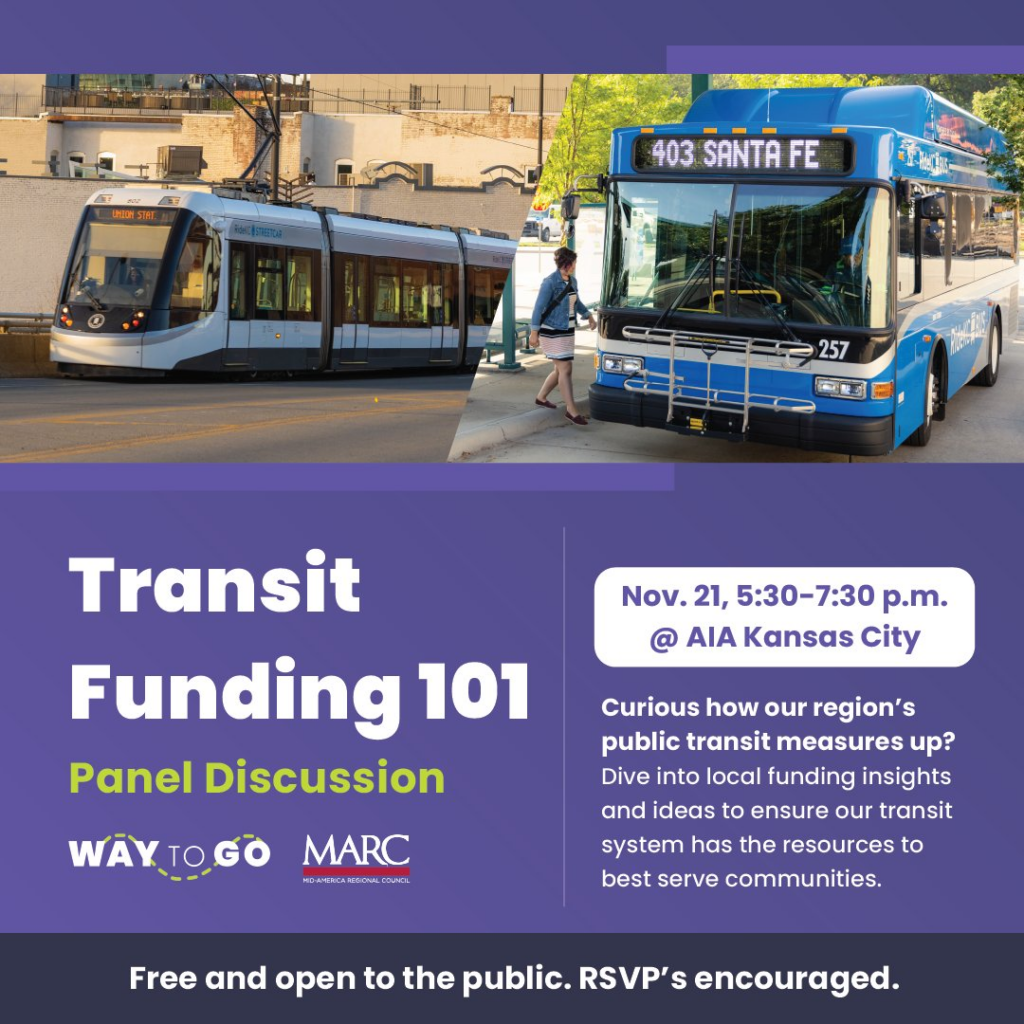
KCRTA will participate in a panel discussion on transit funding. The session will also include background on how transit is funded today and the results of recent survey work conducted by Mid-America Regional Council.
https://www.marc.org/event/transit-funding-101